Closest Known Galaxy Just Discovered
A small galaxy has just been detected as it is being ripped apart and swallowed by the much larger Milky Way. The Canis Major dwarf galaxy, as it is now called, is closer to the center of our galaxy than any previously known.
The discovery, announced today by an international team of astronomers, is further evidence that the Milky Way has built its bulk by mergers and acquisitions. Researchers described the galaxy as a "dismembered corpse."
Canis Major dwarf is, on average, about 25,000 light-years from our solar system and some 42,000 light-years from the center of the Milky Way. This is closer than the previous leader in proximity, the Sagittarius dwarf galaxy, discovered in 1994.
The new galaxy does not look like the Milky Way. Besides containing far fewer stars, it is stretched into a shape quite unbecoming to a regular galaxy. In fact, Canis Major dwarf forms a sort of ring around the Milky Way -- a clue to how its being torn apart and swallowed up.
Astronomers found it by detecting several cool, red stars that are otherwise rare in the Milky Way.
"On galactic scales, the Canis Major dwarf galaxy is a lightweight of about only one billion Suns," said Michele Bellazzini of Bologna Observatory, another member of the team. "This small galaxy is unlikely to hold together much longer. It is being pushed and pulled by the colossal gravity of our Milky Way, which has been progressively stealing its stars and pulling it apart."
The galactic snack may be adding 1 percent more mass to the Milky Way, the astronomers estimate.
The discovery was made using data from the Two-Micron All Sky Survey (2MASS). The cool stars, previously undetectable through the dust of the Milky Way, shine brightly in infrared light.
"It's like putting on infrared night-vision goggles," said Rodrigo Ibata of Strasbourg Observatory. "We are now able to study a part of the Milky Way that has been previously out of sight."
Like other digested galaxies, the Canis Major dwarf will eventually live on only as individual stars. Despite the violent ripping apart of its structure, the odds of any star actually colliding with another during the merger are very slim, scientists say.
The finding will be published in the Monthly Notices of the Royal Astronomical Society.

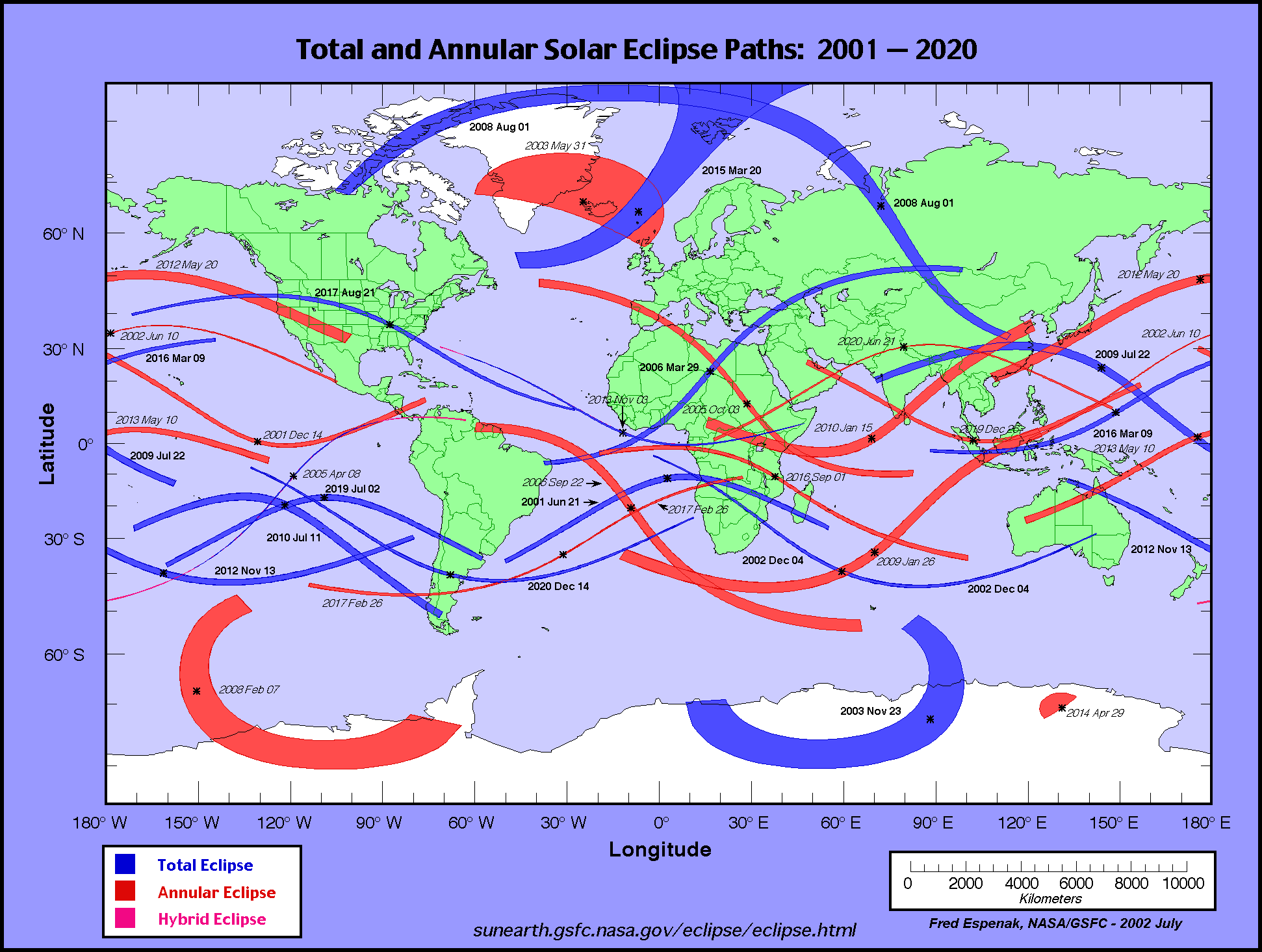
| Solar Eclipses of 2010 | |
| Annular Solar Eclipse of 2010 Jan 15 | Total Solar Eclipse of 2010 Jul 11 |
 Special web page for the Annular Solar Eclipse of 2010 Jan 15 |  Special web page for the Total Solar Eclipse of 2010 Jul 11 |
View Sky Calendar for: Current Month
View Sky Calendar for Year: | 2008 | 2009 | 2010 | 2011 | 2012 | 2013 | 2014 | 2015 | 2016 | 2017 | 2018 | 2019 | 2020 |
Eclipses of the Sun
- Solar Eclipse - main directory for NASA's Solar Eclipse Page (some popular links below)
- Predictions for Total Solar Eclipses of 2008, 2009 and 2010
- Total Solar Eclipse of 2008 Aug 01
- Total Solar Eclipse of 2009 Jul 22
- Annular Solar Eclipse of 2010 Jan 15
- Total Solar Eclipse of 2010 Jul 11
- Eclipses During: | 2000 | 2001 | 2002 | 2003 | 2004 | 2005 | 2006 | 2007 | 2008 | 2009 | 2010 |
- Decade Solar Eclipse Tables:
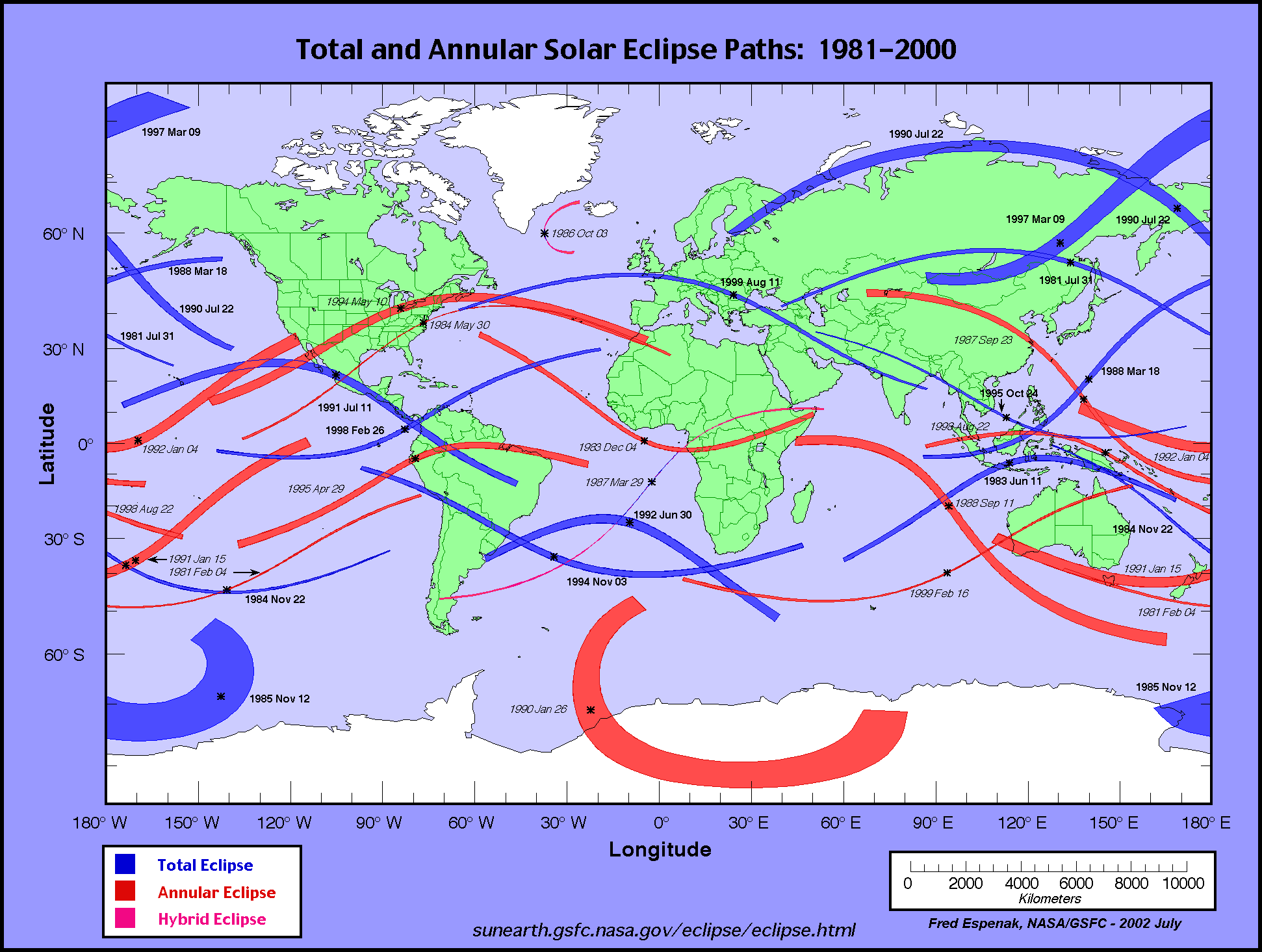
- | 1951 - 1960 | 1961 - 1970 | 1971 - 1980 | 1981 - 1990 | 1991 - 2000 |
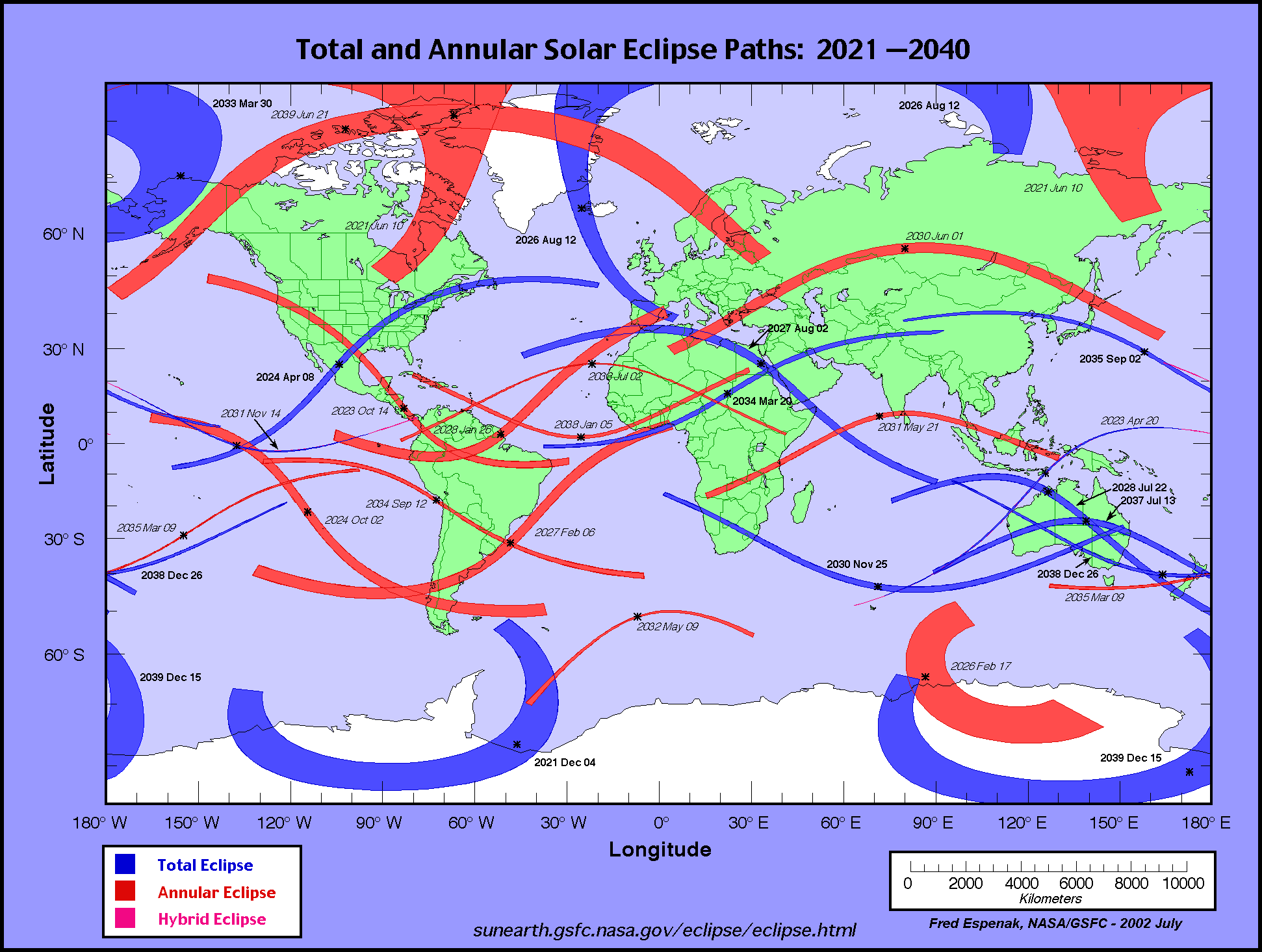
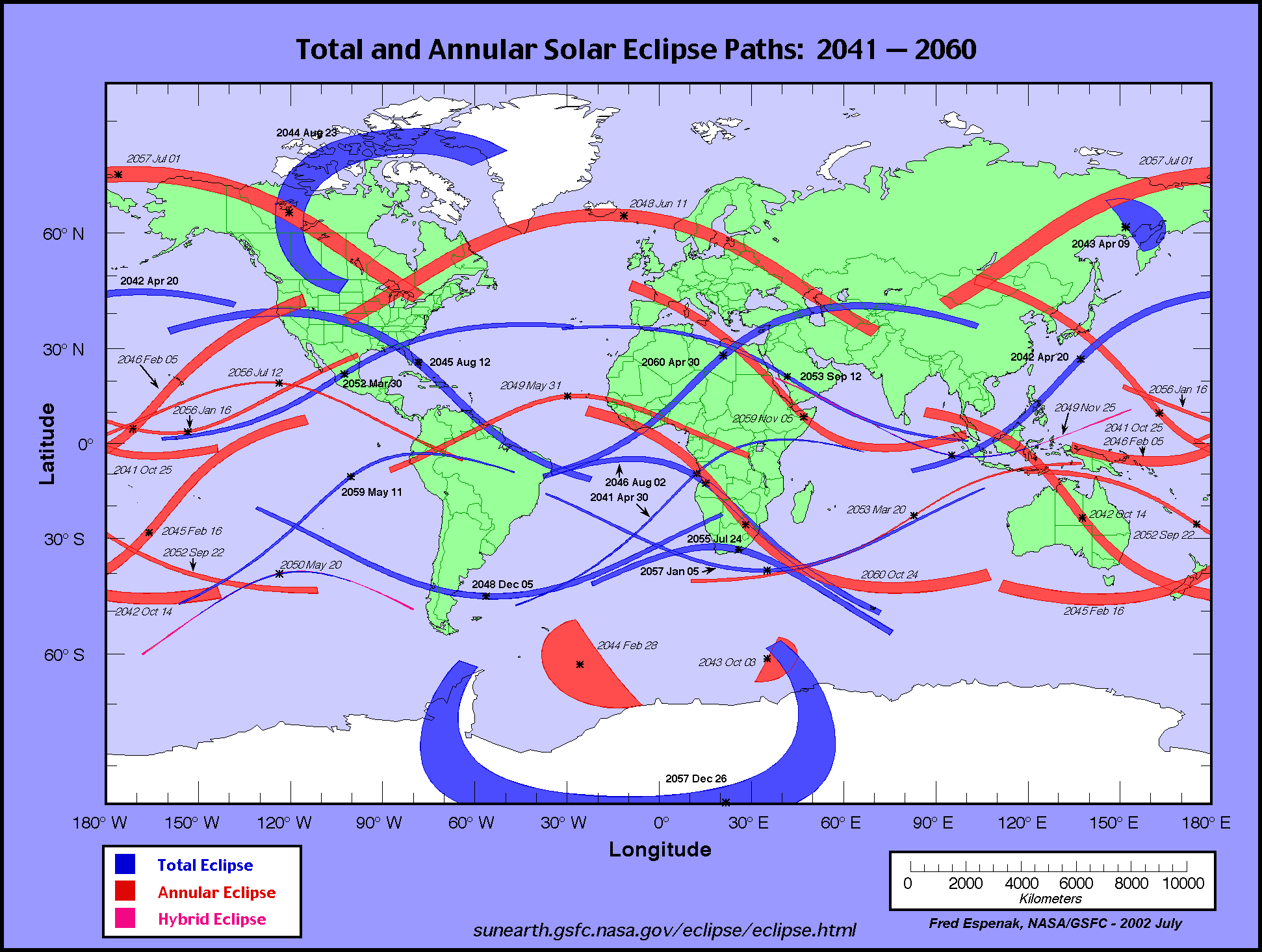
- | 2001 - 2010 | 2011 - 2020 | 2021 - 2030 | 2031 - 2040 | 2041 - 2050 |
- Solar Eclipses on Google Maps:
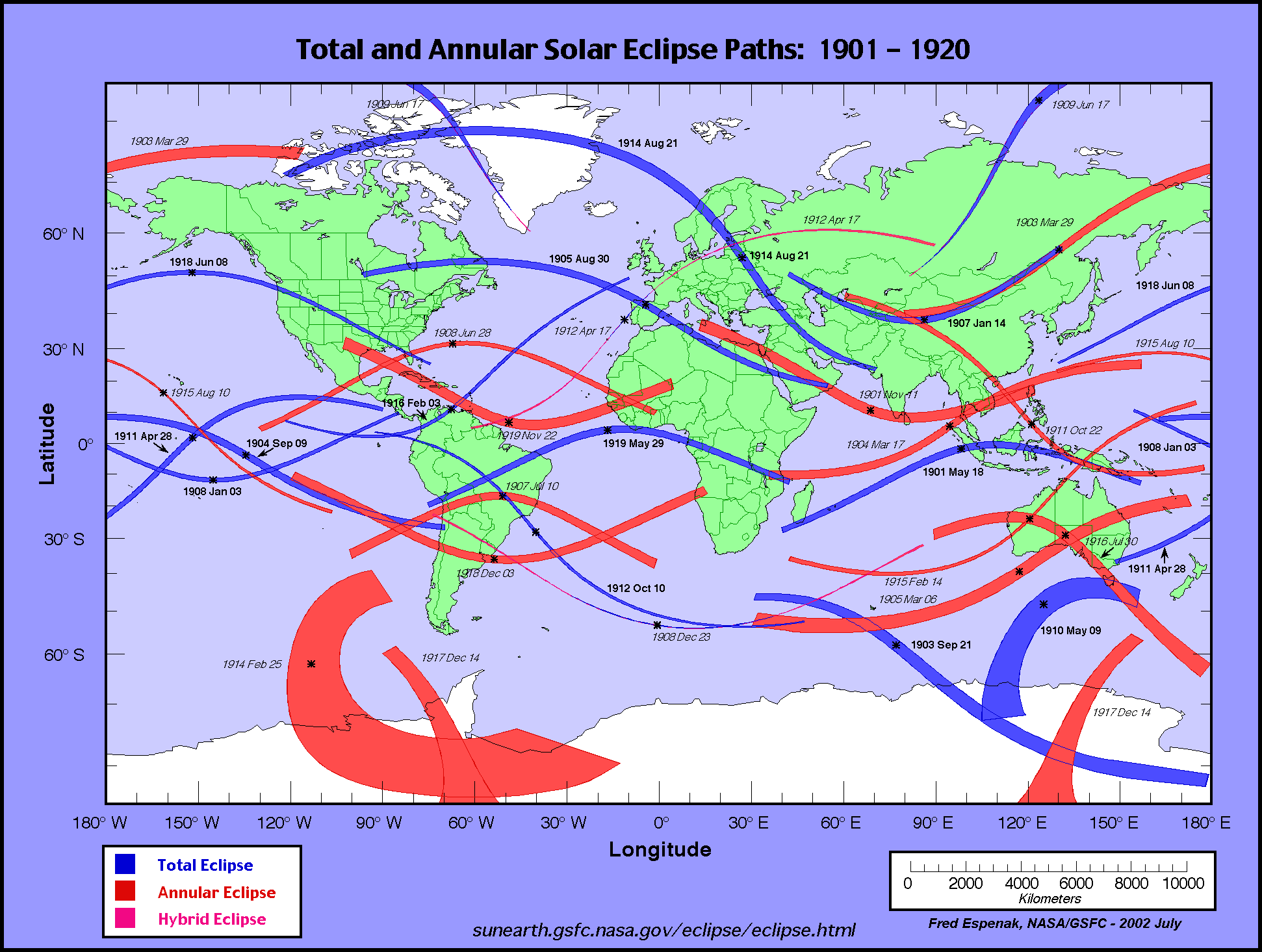
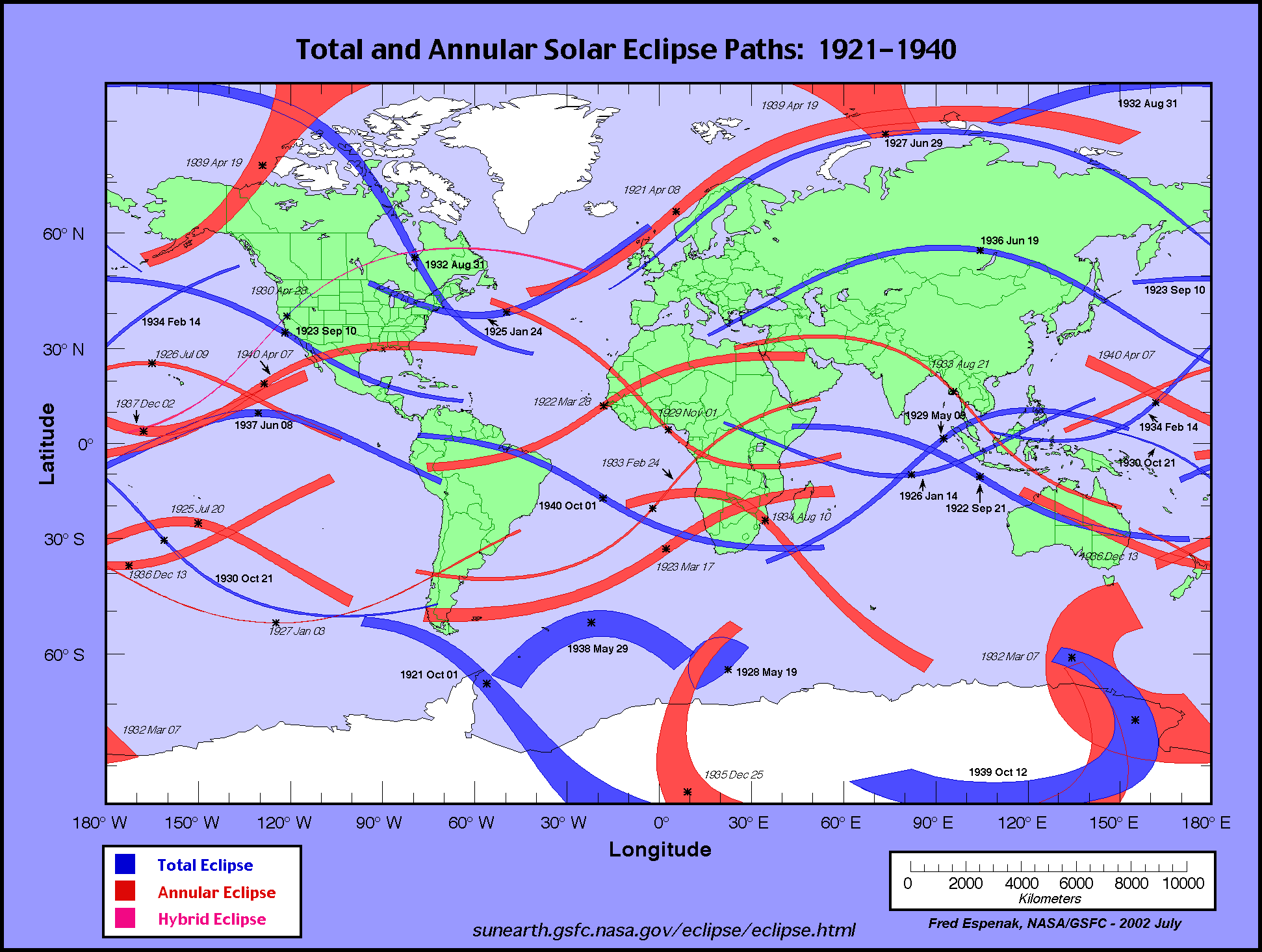
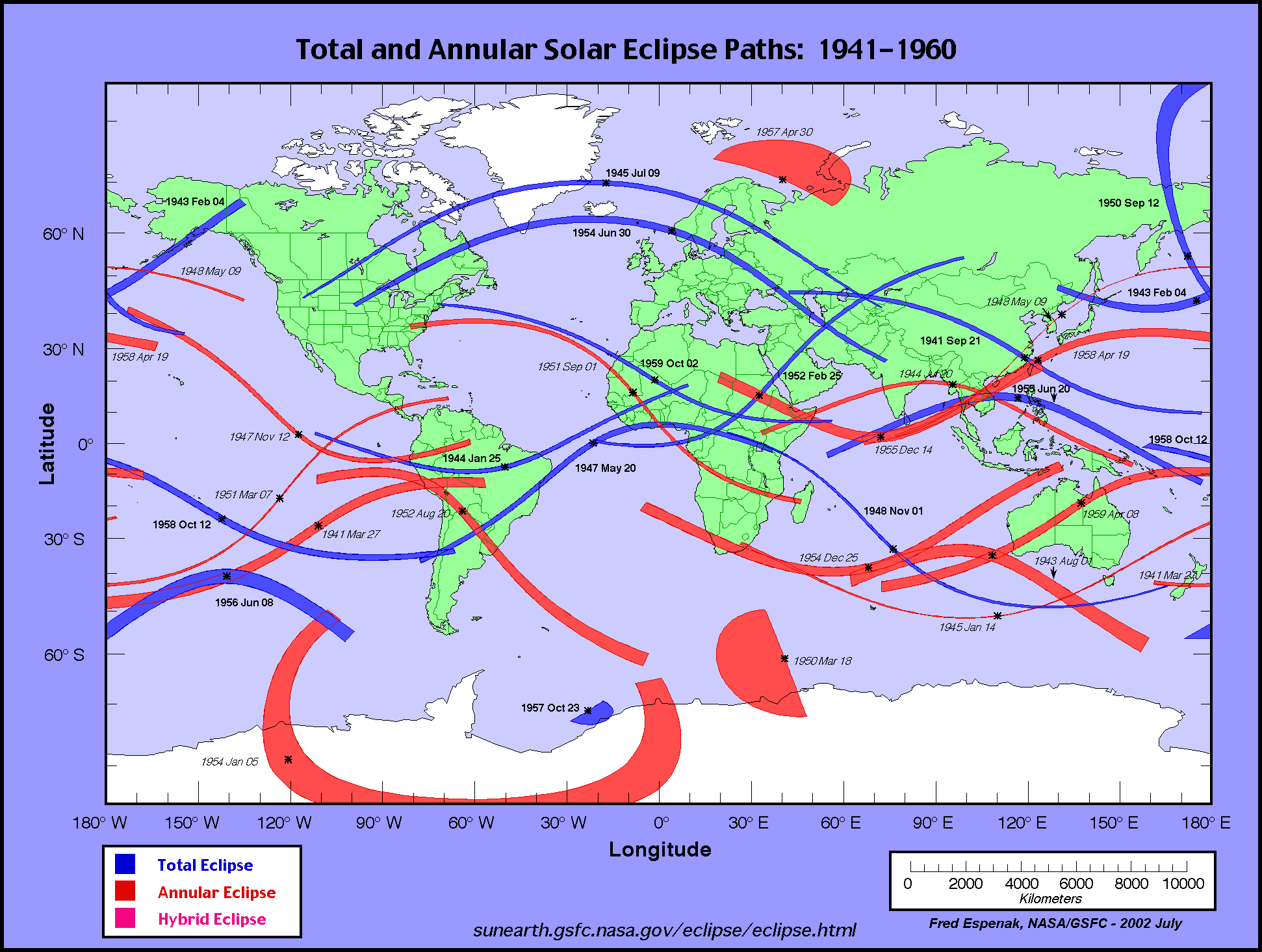
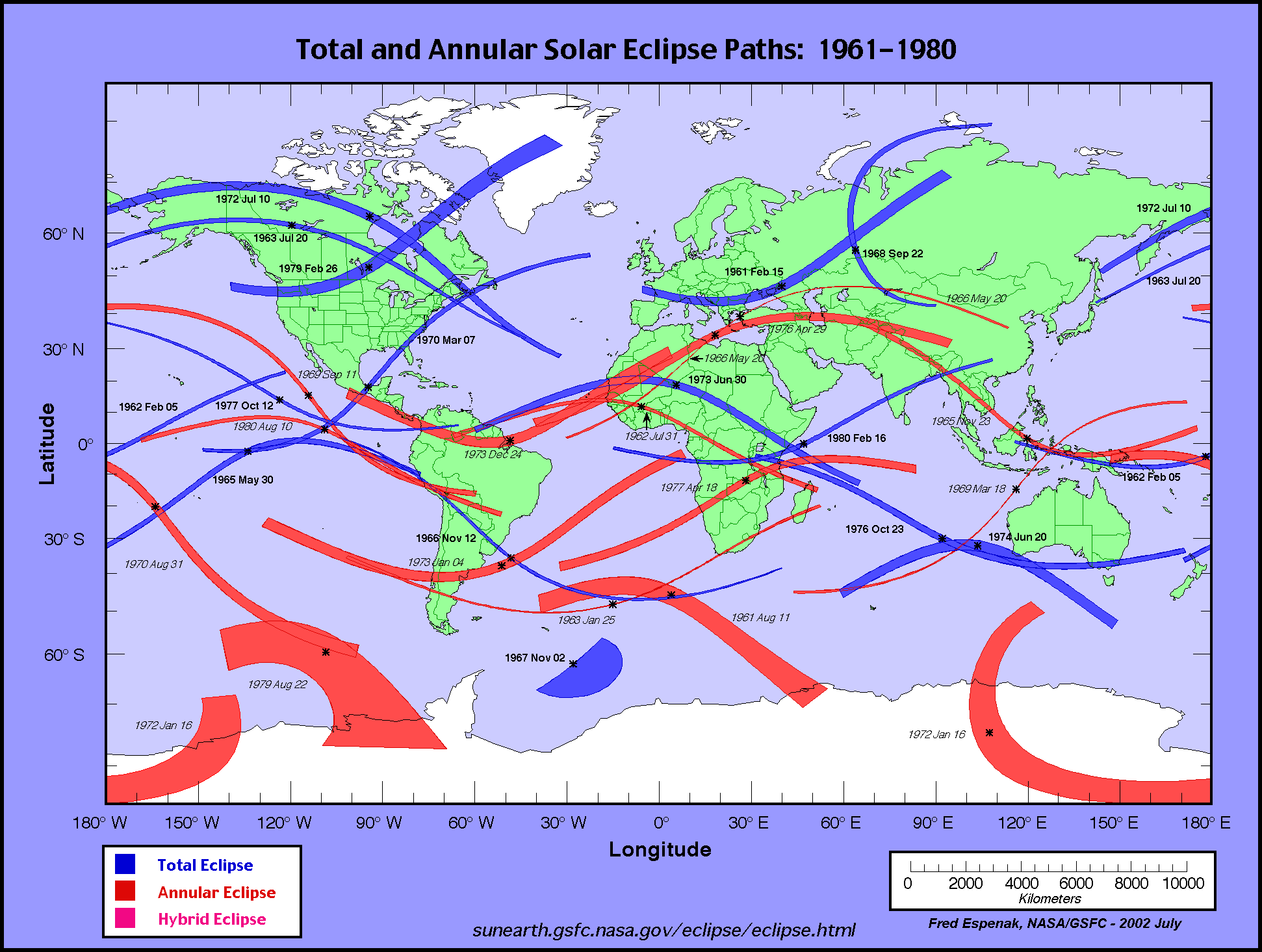
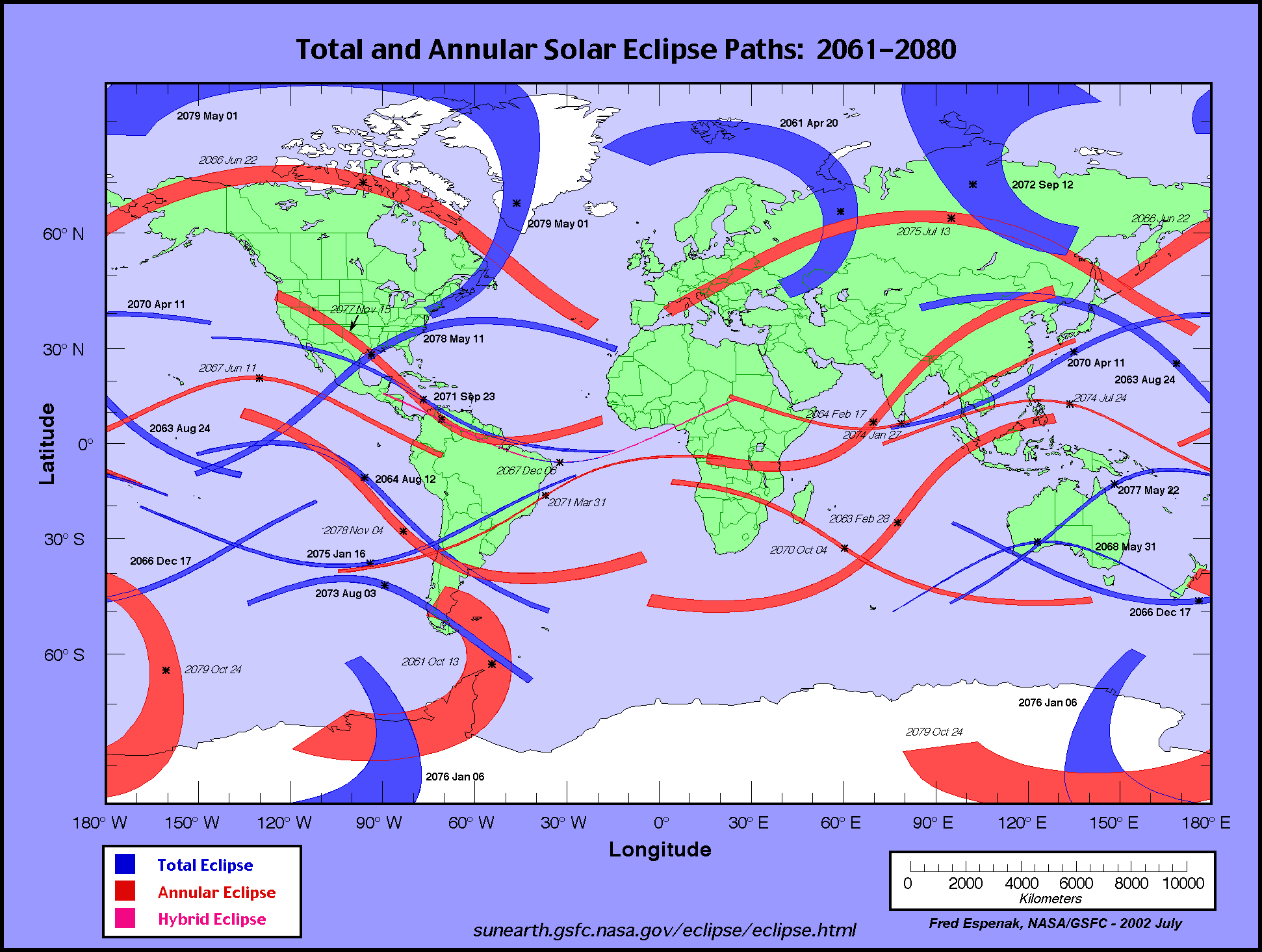
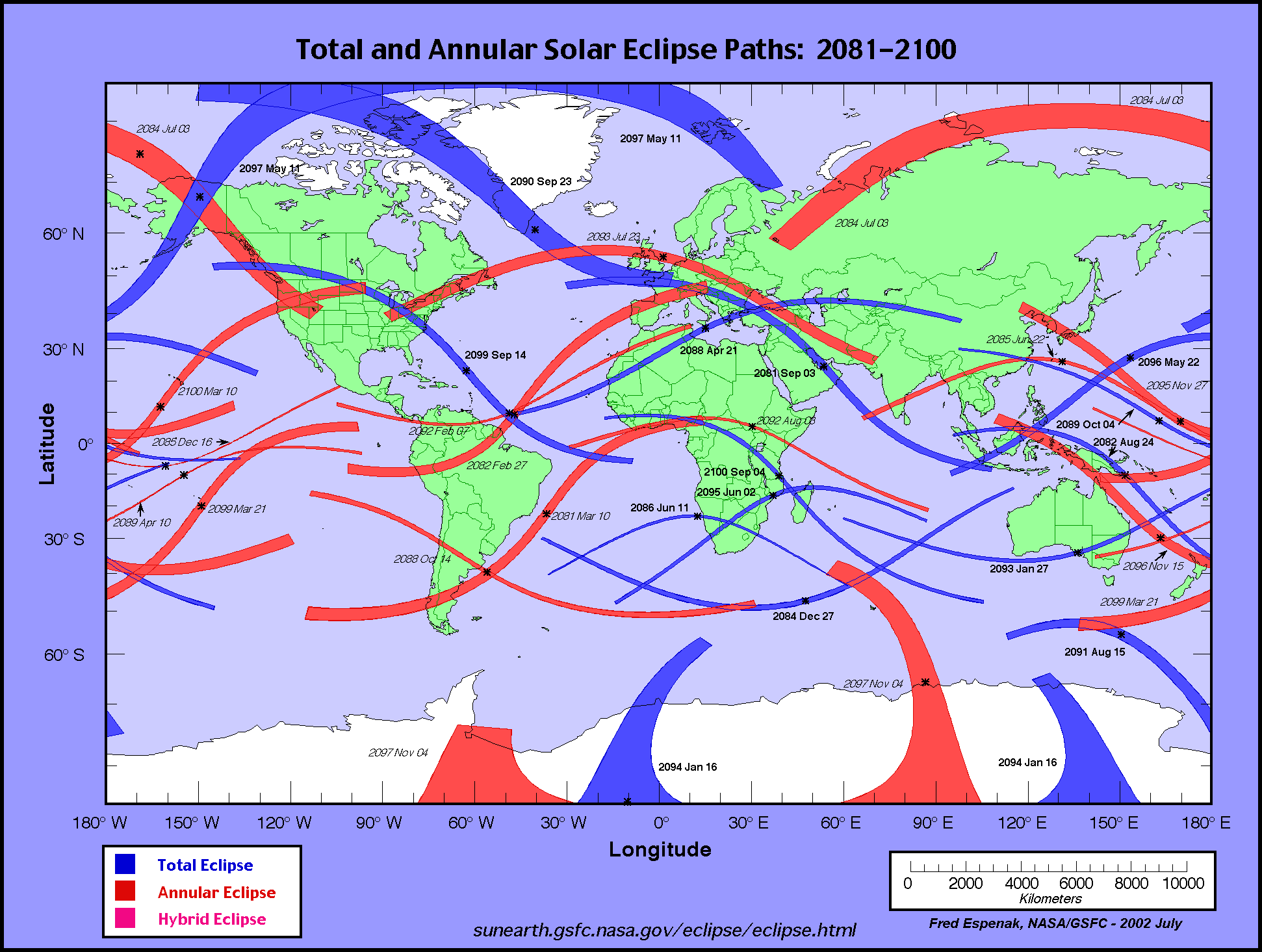
- | 1901 - 1920 | 1921 - 1940 | 1941 - 1960 | 1961 - 1980 | 1981 - 2000 |
- | 2001 - 2020 | 2021 - 2040 | 2041 - 2060 | 2061 - 2080 | 2081 - 2100 |
- World Atlas of Solar Eclipse Maps: Index Page
- | 1901 - 1920 | 1921 - 1940 | 1941 - 1960 | 1961 - 1980 | 1981 - 2000 |
- | 2001 - 2020 | 2021 - 2040 | 2041 - 2060 | 2061 - 2080 | 2081 - 2100 |
- North America Solar Eclipse Maps: 1851-2100 - Index Page
- NASA Solar Eclipse Bulletins
- Five Millennium Catalog of Solar Eclipses: -1999 to +3000
- Five Millennium Solar Eclipse Search Engine - search for solar eclipses and plot on Google maps
- Javascript Solar Eclipse Explorer - calculate all solar eclipses visible from a city
Eclipses of the Moon
- Lunar Eclipse - main directory for NASA's Lunar Eclipse Page (some popular links below)
- Eclipses During: | 2000 | 2001 | 2002 | 2003 | 2004 | 2005 | 2006 | 2007 | 2008 | 2009 | 2010 |
- Decade Lunar Eclipse Tables:
- | 1951 - 1960 | 1961 - 1970 | 1971 - 1980 | 1981 - 1990 | 1991 - 2000 |
- | 2001 - 2010 | 2011 - 2020 | 2021 - 2030 | 2031 - 2040 | 2041 - 2050 |
- Five Millennium Catalog of Lunar Eclipses: -1999 to +3000
- Javascript Lunar Eclipse Explorer - calculate all lunar eclipses visible from a city
Planetary Transits Across the Sun
- Planetary Transits - main directory for NASA's Transits Page (some popular links below)
- 2004 Transit of Venus
- 2004 & 2012 Transits of Venus
- 2006 Transit of Mercury
- Seven Century Catalog of Mercury Transits: 1600 CE to 2300 CE
- Six Millennium Catalog of Venus Transits: 2000 BCE to 4000 CE
Solar System Data
- Generate sky events calendar: SKYCAL: Sky Events Calendar
- Sky Events Calendars: | 2005 | 2006 | 2007 | 2008 | 2009 | 2010 | 2011 | 2012 | 2013 | 2014 | 2015 |
- Phases of the Moon from 2001 to 2025 (select Time Zone)- [UT] [EST] [CST] [MST] [PST]
- Phases of the Moon from -1999 to +4000 - Six Millennium Year Catalog of the Phases of the Moon
- Celestial coordinates for Sun, Moon and planets: Twelve Year Planetary Ephemeris: 1995 - 2006
- Planetary Phenomena from 1995 to 2010 -
- | 1995 | 1996 | 1997 | 1998 | 1999 | 2000 | 2001 | 2002 | 2003 | 2004 | 2005 | 2006 | 2007 | 2008 | 2009 | 2010 |
All eclipse calculations are by Fred Espenak, and he assumes full responsibility for their accuracy. Some of the information presented on this web site is based on data originally published in Fifty Year Canon of Solar Eclipses: 1986 - 2035, Fifty Year Canon of Lunar Eclipses: 1986 - 2035, Five Millennium Canon of Solar Eclipses: -1999 to +3000 , Five Millennium Catalog of Solar Eclipses: -1999 to +3000, Five Millennium Canon of Lunar Eclipses: -1999 to +3000 , and Five Millennium Catalog of Lunar Eclipses: -1999 to +3000.
Permission is freely granted to reproduce this data when accompanied by an acknowledgment:
"Eclipse Predictions by Fred Espenak, NASA/GSFC"
Sunrise is the instant at which the upper edge of the Sun appears above the horizon in the east. Sunrise should not be confused with dawn, which is the (variously defined) point at which the sky begins to lighten, some time before the sun itself appears, ending twilight. Because atmospheric refraction causes the sun to be seen while it is still below the horizon, both sunrise and sunset are, from one point of view, optical illusions. The sun also exhibits an optical illusion at sunrise similar to the moon illusion.
The apparent westward revolution of Sun around the earth after rising out of the horizon is due to the Earth's eastward rotation, a counter-clockwise revolution when viewed from above the North Pole. This illusion is so convincing that most cultures had mythologies and religions built around the geocentric model. This same effect can be seen with near-polar satellites as well.
Sunrise and sunset are calculated from the leading and trailing edges of the Sun, and not the center; this slightly increases the duration of "day" relative to "night". The sunrise equation, however, is based on the center of the sun.
The timing of sunrise varies with the time of year and the latitude of the location from which it is viewed. The precise local time of sunrise also depends upon each location's precise longitude within a given time zone. Small daily changes and noticeable semi-annual changes in timing of sunrise are driven by the axial tilt of Earth and the planet's movement in its annual orbit around the sun. Some apparent anomalies exist however. In the Northern Hemisphere, the latest sunrise does not occur on the winter solstice around December 21, but rather in early January. Likewise, the earliest sunrise does not fall on the summer solstice around June 21, but occurs earlier in June in the Northern Hemisphere. As one travels farther from the equator, the times of sunrise and sunset change throughout the year. Even on the equator, sunrise and sunset shift several minutes back and forth through the year, along with solar noon. These effects are plotted using an analemma.
Due to Earth's axial tilt, whenever and wherever sunrise occurs, it is always in the northeast quadrant from the March equinox to the September equinox and in the southeast quadrant from the September equinox to the March equinox. Sunrises occur precisely due east on the March and September equinoxes for all viewers on Earth. The sunrise and sunset times for a 12 hr day and 12 hr night do not fall on the "equinox" (equal night), since the timing of sunrises and sunsets, and hence, the lengths of day and night vary with each viewer's particular latitude.

 A sunrise with the typical orange colour in the sky (south beach of Jamaica).The intense red and orange hues of the sky at sunrise and sunset are mainly caused by scattering of sunlight by dust particles, soot particles, other solid aerosols, and liquid aerosols in the Earth's atmosphere. These enhanced red and orange colors at sunrise and sunset are mathematically explained by the Mie theory or the discrete dipole approximation. When there are no particulates in the troposphere, such as after a big rain storm, then the remaining less intense reds are explained by Rayleigh Scattering of sunlight by air molecules. Sunrise colors are typically less brilliant and less intense than sunset colors, since there are generally fewer particles and aerosols in the morning air than in the evening air. Nighttime air is usually cooler and less windy, which allows dust and soot particles to settle out of the atmosphere, reducing the amount of Mie Scattering. The reduced Mie Scattering correspondingly reduces the amount of red and orange scattered light at sunrise. Sunrise color intensities can however exceed sunset's intensities when there are nighttime fires, volcanic eruptions or emissions, or dust storms to the east of the viewer. A number of eruptions in recent times, such as those of Mount Pinatubo in 1991 and Krakatoa in 1883, have been sufficiently large to produce remarkable sunsets and sunrises all over the world.
Sometimes just before sunrise or after sunset a green flash can be seen. [1] [2] [3]
The apparent westward revolution of Sun around the earth after rising out of the horizon is due to the Earth's eastward rotation, a counter-clockwise revolution when viewed from above the North Pole. This illusion is so convincing that most cultures had mythologies and religions built around the geocentric model. This same effect can be seen with near-polar satellites as well.
Sunrise and sunset are calculated from the leading and trailing edges of the Sun, and not the center; this slightly increases the duration of "day" relative to "night". The sunrise equation, however, is based on the center of the sun.
The timing of sunrise varies with the time of year and the latitude of the location from which it is viewed. The precise local time of sunrise also depends upon each location's precise longitude within a given time zone. Small daily changes and noticeable semi-annual changes in timing of sunrise are driven by the axial tilt of Earth and the planet's movement in its annual orbit around the sun. Some apparent anomalies exist however. In the Northern Hemisphere, the latest sunrise does not occur on the winter solstice around December 21, but rather in early January. Likewise, the earliest sunrise does not fall on the summer solstice around June 21, but occurs earlier in June in the Northern Hemisphere. As one travels farther from the equator, the times of sunrise and sunset change throughout the year. Even on the equator, sunrise and sunset shift several minutes back and forth through the year, along with solar noon. These effects are plotted using an analemma.
Due to Earth's axial tilt, whenever and wherever sunrise occurs, it is always in the northeast quadrant from the March equinox to the September equinox and in the southeast quadrant from the September equinox to the March equinox. Sunrises occur precisely due east on the March and September equinoxes for all viewers on Earth. The sunrise and sunset times for a 12 hr day and 12 hr night do not fall on the "equinox" (equal night), since the timing of sunrises and sunsets, and hence, the lengths of day and night vary with each viewer's particular latitude.
Colors

Sometimes just before sunrise or after sunset a green flash can be seen. [1] [2] [3]
Print your own custom sunrise and sunset calendar. Moonrise and moonset time and moon phase information is also available. There is a list of predefined cities or you can enter your own location and get a calendar for anywhere in the world. For users of Windows 95, 98, NT 4.0, XP and Vista operating systems, SunriseSunset.com also offers a shareware product, Sunrise Sunset Calculator. It is a 'System Tray' application that provides you with a daily report on the sunrise, sunset and various twilight times for your location. Download it and try it out.
http://www.sunrisesunset.com/
http://www.sunrisesunset.com/
First Sunset Outside Our Solar System Glimpsed
By Dave Mosher
Staff Writer
posted: 11 December 2007
06:02 am ET

Traces of a distant extrasolar planet's hazy red sunset have been detected for the first time.
Astronomers pointed the Hubble Space Telescope HD 189733b, a gaseous Jupiter-like world about 63 light-years from Earth, as it passed in front of its parent star to catch a glimpse of the planet's atmosphere. Previous observations have not revealed much about the planet's atmosphere, other than that it has clouds.
"One of the long-term goals of studying extrasolar planets is to measure the atmosphere of an Earth-like planet [and] this present result is a step in this direction," said Frederic Pont, an astronomer at the Geneva University Observatory in Switzerland. Pont led the team of astronomers who made the new Hubble observations.
"HD 189733b is the first extrasolar planet for which we are piecing together a complete idea of what it really looks like," Pont said.
Starlight passing through a planet's outer atmosphere can take on different colors as it passes through different gases. In the case of HD 189733b, scientists said the light traveling through the planet's hazy atmosphere appeared red in front of its yellow star, which is about 76 percent of the diameter of the sun.
They expected to see the fingerprints of sodium, potassium and water in the red haze, but instead discovered iron, silicate and aluminum oxide (which sapphire gems are made of). The composition is similar to Venus and Saturn's moon Titan—both worlds with chokingly thick air.
So far, HD 189733b isn't thought to harbor any Earth-sized moons or Saturn-like rings, but more powerful telescopes of the future might detect them.
By Dave Mosher
Staff Writer
posted: 11 December 2007
06:02 am ET

Astronomers pointed the Hubble Space Telescope HD 189733b, a gaseous Jupiter-like world about 63 light-years from Earth, as it passed in front of its parent star to catch a glimpse of the planet's atmosphere. Previous observations have not revealed much about the planet's atmosphere, other than that it has clouds.
"One of the long-term goals of studying extrasolar planets is to measure the atmosphere of an Earth-like planet [and] this present result is a step in this direction," said Frederic Pont, an astronomer at the Geneva University Observatory in Switzerland. Pont led the team of astronomers who made the new Hubble observations.
"HD 189733b is the first extrasolar planet for which we are piecing together a complete idea of what it really looks like," Pont said.
Starlight passing through a planet's outer atmosphere can take on different colors as it passes through different gases. In the case of HD 189733b, scientists said the light traveling through the planet's hazy atmosphere appeared red in front of its yellow star, which is about 76 percent of the diameter of the sun.
They expected to see the fingerprints of sodium, potassium and water in the red haze, but instead discovered iron, silicate and aluminum oxide (which sapphire gems are made of). The composition is similar to Venus and Saturn's moon Titan—both worlds with chokingly thick air.
So far, HD 189733b isn't thought to harbor any Earth-sized moons or Saturn-like rings, but more powerful telescopes of the future might detect them.

He first occurred when I was the ripe old age of 17. I had just finished school and was taking on the world. And this consisted of working in a Roadhouse in the middle of the Nullarbor Plain; a small place with a population of 17.
I was employed to pump petrol, empty rubbish bins, paint signposts and weed the airstrip (yes, I actually did that!); kind of ado-the-jobs-that-nobody-else-wants-to-do job. This roadhouse was situated pretty well exactly on the border of South Australia and Western Australia on the main highway, the Eyre Highway, that connects Perth to the rest of the country, and, in fact, the world. We were about 5km inland and situated at the western most end of the astounding Nullarbor cliffs: 300 feet of sheer rock face that plummet vertically to the surf below, and extends like a billiard table to the horizon the other way. Being a roadhouse, we were besieged my the monstrous road trains that ply the routes with all manner of goods, shipping things furiously from A to B and then back again with monotonous regularity, and we were quite well known along the route as a good place to stop. However, to make sure that we actually attracted people, they had built a rather imposing sign, some 15 stories high, announcing to the approaching world that we were in fact here, and if you felt like stopping, this might be a good place. This sign was also neon lit, and in my list of jobs, it was included that should a bulb need changing, I was the very man for the job. Needless to say I became somewhat adept at scaling the ladder with a fluorescent tube nestled between my pubescent teeth.And it was on one of these vertical sojourns that I undertook at dusk, that I witnessed the spectacle of nature’s finest. When you are 15 stories above the Nullarbor plain, and there is not a single sound to be heard for miles, and the sun dips graciously below the extended horizon, you kind of want to commit that moment to memory. The sky was massive, streaked with the wisps of jetstream, and gently pulped with the odd ball of cotton wool, and before my eyes, I saw the sky change from the fierce blue of the day to the intoxicating light that is the Nullarbor night. It seemed as if all the colours in the world wanted to have a look at his sight so they were all jostling for position, and I watched them all pass before my eyes in a matter of minutes. If you can ever procure a photograph of that sky from that sign, it will surely be up there with all the rest.The second great sunset, I have already committed to paper, and my short description is copied below. This one occurred in Tasmania along the winding road from Port Arthur to Hobart. I stopped by a lake and quite simply was unable to conjure up any words to describe it.
The sun was thinking about retiring, so I joined it in its thoughts. Recalling the names of the places I wished to stop along the way, I retraced. What I now discovered was that as we were surrounded by hills, the sun, this solar supplier of things toasty, was now behind most of them, and had selfishly taken its heat with it. It got cold. Nowhere near the arctic conditions of the first jaunt off the ferry, but cool enough. I stopped at the Tasman Blowhole, which like all blowholes the world over (a small natural hole carved from the rock by the relentless pounding of the sea, through which waves supposedly shoot skyward) steadfastly refused to blow. Maybe it’s just me, but I have visited many natural things all called blowholes, and I have been singularly disappointed each time in the complete lack of any blowing action whatsoever. But I tried it again, hoping to prove my depressing theory false. But it wasn't to be. The Tasman Arch was exactly that: an arch carved through a cliff face, and the Tessellated Pavement proved to be marginally more fascinating: a geological anomaly in which perfect squares appear to be etched in a flat rock base through movements of the various plates on which we are seated.
But the masterpiece was to come. I began noticing the sky changing colours as the sun began its daily retirement. I stopped next to a stretch of water and watched the most amazing sunset I have ever seen. The sky changed colour so quickly I found it hard to keep up. Deep reds morphing to purple, brightly reflected off stringy clouds that seemed to hang in the air in the same manner that bricks don’t. I stood transfixed for an undetermined period of time, solitary, fascinated. Again, my Lennon-McCartney issue (see below) joined me and I very successfully failed to discover any words to accurately represent this sight. So I packed up the sunset, took it with me as well, and returned to the road.
The Lennon-McCartney reference may need some explaining so here it is. This was all taken from a journal that I wrote after the week-long motorcycle trip around Tasmania in 2006 I believe.
For years, I have had a theory. That everything in the world comes into two characteristics. And so far, I have yet to be proven wrong. Now these characteristics, traits, call them what you will are diametric opposites: the yin and yang, black and white, Lennon and McCartney, good and evil, John Smith and Pocahontas.. You get the idea. One characteristic is Science: clinical, exact, educational, quantifiable in every way. The other is Art, emotional, expressive, beautiful, appreciative. And here is my dilemma: I experienced beauty, appreciated life and fought emotions, all things falling under the Art banner. And now I am trying to quantify and describe them using words, grammar and facts under the Science banner. You see my problem. Never the twain shall meet, and yet writers, musicians and artists the world over throughout time have been trying to do the same. Using only words to describe beauty that makes your heart sing, or trying to use mere words to describe the passion and heart stirring feeling that is love. Sure, there are astounding adjectives for all seasons, but you will never be able to write and accurately describe an emotion. The reason it can’t be done is simple: feelings and love is Art, and words are Science. Never the twain shall meet. So in essence, this is going to be a pathetic attempt to evoke emotions that only I felt, by using the very public forum of the majesty of words. And if that doesn’t make any sense, I really don’t care!
So there you have it. Hope you find the best sunset in the world, and when you do, please let me know. I shall be there, camera in tow with a complete absence of words.
The World's Best Sunsets
Solstice Moon
This week's Full Moon, which takes place just four days before the summer solstice, will appear unusually big and colorful to observers in the northern hemisphere.
 June 14, 2000 -- As moms and dads can testify, the lengthening days of June present some special parenting challenges. For example, have you ever tried to explain to a 3-year old how it can possibly be bedtime when the Sun is still shining outside? The tricky part is describing the tilt of the Earth's axis and the approaching summer solstice. Most kids -- even the children of astronomers -- just won't buy it.
On June 16, 2000, the problem could be even worse than usual. Instead of a dark, sleepy night sky following sunset, the blazing rays of a bright full Moon will come streaming through bedroom windows. This June's full Moon occurs just 4 days before the 2000 summer solstice -- the longest day of the year in the northern hemisphere.
Right: Duane Hilton's rendering of moonrise over Half Dome in Yosemite National Park.
"Full Moons that occur close to the summer solstice are special because they follow the lowest path across the sky of all of the year's full Moons." explains Dr. George Lebo, a NASA/Marshall Space Flight Center Summer Faculty Fellow. "Moons seen just above the horizon look much larger than normal. It's an optical illusion, of course, but it's still a pretty sight."

According to the most popular explanation, which springs from the "apparent distance theory" offered by psychologists Kaufman and Rock in 1962, a moon viewed near the horizon seems farther away than one shining down from overhead. Curiously,
 this causes the horizon Moon to appear bigger (we usually think of more distant objects as appearing smaller). The effect is similar to the 'Ponzo' railroad track illusion, illustrated here.
Right: In 1913 Mario Ponzo presented the well-known railroad track illusion in which two identical bars are drawn across a pair of converging lines. The upper yellow bar appears much larger because it spans a greater apparent distance between the rails. In fact, the two bars are exactly the same width. This effect may be at work with the mysterious horizon moon illusion. Distance cues like foreground mountains and trees may cause the horizon moon to appear more distant than a moon that is high in the sky. As in the Ponzo illusion, the more distant-seeming Moon appears wider. In fact, the Moon subtends a constant 1/2 degree angle no matter how high it is above the horizon. It's all a trick of the eye.
 Send this page to a friend! |
The illusory nature of June's swollen full Moon won't detract from its beauty. In fact, not only will the Moon seem bigger than normal on June 16, but it's likely to appear more colorful, too. For the same reason that sunsets can be vivid red, the low-hanging moon frequently takes on a beautiful pink or orange hue as a result of scattered moonlight in Earth's dusty atmosphere.
 Jack Horkheimer, of the Miami Museum of Science and Space Transit Planetarium, notes that the term honeymoon may have its origins in the fact that the full moon of June often looks honey-colored and June is traditionally a month of many marriages. [ref]
This brings us back to 3-year olds. If your children are still awake after sunset on June 16, a field trip to the back yard for a view of June's wonderful full moon may be in order. A fun activity to try is looking at the moon directly and then through an aperture (e.g., 'pinch' the moon between your thumb and forefinger or view it through a tube, which hides the foreground terrain). Can you make the optical illusion vanish? The best times to try will be during the hours just after sunset (or before sunrise) when the bright moon is as low as possible.
Above: This picture of the full Moon was captured on 22 December, 1999, by photographer Rob Gendler. The light regions are very old heavily-cratered highlands. The dark 'maria' (seas) are huge impact craters that were later flooded by molten lava. Most of the Moon's surface is covered with regolith, a mixture of fine dust and rocky debris produced by meteor impacts. [more information about the Moon from the Nine Planets web site]
Mercury Rising
On Saturday evening, June 3, a slender crescent Moon and the elusive planet Mercury will appear together for stargazers just after sunset.
 June 2, 2000 -- There will be two good times to see the elusive planet Mercury this year, and next week is one of them.
Mercury is the solar system's innermost planet, so it never strays very far in the sky from the blinding glare of the Sun. Its angular separation from the Sun (or elongation) is always less than 28 degrees. Mercury approaches its maximum eastern elongation on June 9, 2000. It will be 24 degrees from the Sun, appearing as a bright zero-magnitude object above the western horizon after sunset.
Above : Artist Duane Hilton's rendition of the close encounter between the Moon and Mercury after sunset on Saturday, June 3, 2000. The setting is Yosemite National Park in north-central California. The Moon and Mercury will appear close together in the sky, but they are really very far apart. On June 3, Mercury will be 139 million km from Earth while the Moon is only 359 thousand km away.
While you're enjoying the rare appearance of Mercury in plain view, don't miss another notable sight: cradled in the arms of the slim crescent Moon will appear the ghostly outline of the full Moon, a dim glow that astronomers call "Earthshine."
| Send this page to a friend! |
 "The phase of the Earth as seen from the Moon is nearly full when the Moon is crescent," says Dr. George Lebo, a Marshall Space Flight Center 2000 Summer Faculty Fellow. "Because the Earth is four times bigger than the Moon and is a ten times better reflector, the 'Full Earth' is 160 times brighter than the 'Full Moon.' That's why earthshine is so noticeable."
Left : The western sky on June 9, 2000, just after sunset at mid-Northern latitudes. Mercury appears in the constellation Gemini about 14 degrees above the WNW horizon to mid-latitude observers in both hemispheres.
Now that you've spotted Mercury using the Moon as a finder on June 3, you can watch Mercury's progress in the sky throughout the month. In early June, Mercury will remain at about the same height above the horizon each night if you look at the same time. After the 10th, the planet will head back toward the Sun. By the third week of June, Mercury will be almost impossible to find as it becomes lost in the Sun's glare.
After June, the best time this year to spot Mercury from northern latitudes will be in mid-November when the planet is 14 degrees over the horizon before sunrise.
| dates of maximum elongation for Mercury | elongation | morning or evening star | altitude at sunrise/sunset (as seen from mid-Northern latitudes) |
|---|---|---|---|
| Feb. 14, 2000 | 18o | evening | 12o |
| Mar. 28, 2000 | 27.8o | morning | 7o |
| June 9, 2000 | 24o | evening | 14o |
| July 27, 2000 | 19o | morning | 11o |
| Oct. 6, 2000 | 25o | evening | 4o |
| Nov. 15, 2000 | 19o | morning | 14o |
If it's any consolation to the often-frustrated Earthbound observers of Mercury, NASA spacecraft have a hard time, too. For instance, ground controllers can't point the Hubble Space Telescope toward Mercury because small pointing errors might allow intense sunlight to damage sensitive cameras. The only spacecraft to explore Mercury close-up was Mariner 10, which executed 3 flybys of Mercury in 1974 and 1975, surveying just 45 percent of its surface.
 Last week, astronomers from Boston University announced that they had captured unprecedented ground-based pictures of Mercury covering parts of the planet's surface that Mariner 10 missed. The images, taken at the Mt. Wilson Observatory in California, revealed surface markings similar to the bright craters and dark maria ("seas") found on the Moon. [Boston University Press Release]
Right : This image of a portion of Mercury's surface not photographed by Mariner 10 in 1974-75 was obtained by Boston University astronomers using observations made at the Mt. Wilson Observatory in August 1998. Hundreds of thousands of pictures taken with short time exposures (1/60th) were examined to find the 30 images with the clearest surface markings, taken during instances of "perfect seeing" through the Earth's atmosphere.
The Boston team plans to make more observations this fall. They might even succeed in detecting sodium in Mercury's wispy atmosphere, which consists of atoms blasted off its surface by the solar wind. Because the planet is so hot, these atoms quickly escape into space. In contrast to the stable atmospheres of Earth and Venus, Mercury's atmosphere is constantly being replenished.
Mercury's dynamic atmosphere is just one of the planet's many exotic aspects. Mercury's density is the higher than any planet except the Earth -- its iron core is probably bigger than Earth's entire Moon! It is the only terrestrial planet besides Earth to possess a global magnetic field. Temperatures on the surface of Mercury vary from nearly the highest in the solar system at the equator to among the coldest in permanently shadowed areas at the poles. Radar data suggest that fiery Mercury, like the Moon, actually harbors polar deposits of ice.
In 2004, scientists hope to launch a satellite called MESSENGER (MErcury: Surface, Space ENvironment, GEochemistry and Ranging) to study Mercury in greater detail. The spacecraft is slated to enter orbit around Mercury in 2009 carrying instruments to answer the following questions:
- What is the origin of Mercury's high density?
- What are the composition and structure of its crust?
- What is Mercury's tectonic history, and is its surface shaped by volcanism?
- What is the nature and origin of Mercury's magnetic field?
- What are the characteristics of the thin atmosphere and miniature magnetosphere?
- What is the nature of the mysterious polar caps?

The MESSENGER mission is managed for NASA by the Johns Hopkins University Applied Physics Laboratory in Laurel, MD. The Principal Investigator is Dr. Sean C. Solomon of the Carnegie Institution of Washington. For more complete information on the mission, including animations of the trajectory to Mercury with flybys of Earth, Venus, and Mercury, visit the MESSENGER home page.
Editor's note: the opening line of this story was inspired by a recent episode of Jack Horkheimer's PBS program "Stargazer."
Sunset Planets 8.26.2005 Venus, Jupiter and the Moon are gathering for a beautiful sunset sky show.
August 26, 2005: Something nice is happening in the sunset sky. Venus and Jupiter, the two brightest planets, are converging, and they're going to be beautifully close together for the next two weeks.
 Step outside tonight when the sun goes down and look west. If there are no trees or buildings in the way, you can't miss Jupiter and Venus. They look like airplanes, hovering near the horizon with their lights on full blast. (Venus is the brighter of the two.) You can see them even from brightly-lit cities.
When the sky darkens completely, look to the left of Jupiter for Spica, the brightest star in the constellation Virgo. Although it's a bright star, Spica is completely outclassed by the two planets.
Venus and Jupiter are converging at the noticeable rate of 1o per day, with closest approach coming on September 1st when the two will be a little more than 1o apart. (How much is 1o? Hold your pinky finger at arm's length. The tip is about 1o wide.)

There's a biological reason for this phenomenon: In the back of your eye, near the center of the retina, lies a small patch of tissue called "the fovea" where cones are extra-densely packed. "Whatever you see with the fovea, you see in high-definition," explains Stuart Hiroyasu, O.D., of Bishop, California. "The fovea is critical to reading, driving, watching television; it has the brain's attention." The field of view of the fovea is 5o. When two objects converge to, say, 1o as Venus and Jupiter will do, they can beam into your fovea simultaneously, signaling your brain—attention, please!
After September 1st, the two planets separate, but the show's not over. On September 6th, with Jupiter and Venus still pleasingly close together, the slender crescent Moon will leap up from the sun's glare and join the two planets. Together, they'll form a compact triangle that will simply knock your socks off.
Feel like staring? Do.
 Step outside tonight when the sun goes down and look west. If there are no trees or buildings in the way, you can't miss Jupiter and Venus. They look like airplanes, hovering near the horizon with their lights on full blast. (Venus is the brighter of the two.) You can see them even from brightly-lit cities.
Right: There was a similar close encounter between Jupiter and Venus last November. Pictured here, the two planets shine over Tehran, Iran. Photo credit: Babak A. Tafreshi
Try catching the pair just after sundown and just before the first stars appear. Venus and Jupiter pop into view while the sky is still twilight-blue. The scene has a special beauty.When the sky darkens completely, look to the left of Jupiter for Spica, the brightest star in the constellation Virgo. Although it's a bright star, Spica is completely outclassed by the two planets.
Venus and Jupiter are converging at the noticeable rate of 1o per day, with closest approach coming on September 1st when the two will be a little more than 1o apart. (How much is 1o? Hold your pinky finger at arm's length. The tip is about 1o wide.)

Above: A map of the western sky on Sept. 6, 2005. More sky maps: Aug. 26, 27, 28, 29, 30, 31 and Sept. 1, 2, 3, 4, 5, 6.
When planets are so close together, not only do you notice them, you'll have a hard time taking your eyes off them. They're spellbinding.There's a biological reason for this phenomenon: In the back of your eye, near the center of the retina, lies a small patch of tissue called "the fovea" where cones are extra-densely packed. "Whatever you see with the fovea, you see in high-definition," explains Stuart Hiroyasu, O.D., of Bishop, California. "The fovea is critical to reading, driving, watching television; it has the brain's attention." The field of view of the fovea is 5o. When two objects converge to, say, 1o as Venus and Jupiter will do, they can beam into your fovea simultaneously, signaling your brain—attention, please!
After September 1st, the two planets separate, but the show's not over. On September 6th, with Jupiter and Venus still pleasingly close together, the slender crescent Moon will leap up from the sun's glare and join the two planets. Together, they'll form a compact triangle that will simply knock your socks off.
Feel like staring? Do.
Sunset on Mars

Sunset and twilight images are occasionally acquired by the science team to determine how high into the atmosphere the Martian dust extends, and to look for dust or ice clouds. Other images have shown that the twilight glow remains visible, but increasingly fainter, for up to two hours before sunrise or after sunset. The long Martian twilight (compared to Earth's) is caused by sunlight scattered around to the night side of the planet by abundant high altitude dust. Similar long twilights or extra-colorful sunrises and sunsets sometimes occur on Earth when tiny dust grains that are erupted from powerful volcanoes scatter light high in the atmosphere.
Sunrise and Sunset Calculator
Find sunrise and sunset for a location
 Select a location in the drop-down menu below to see times for sunrise and sunset in that location.
Also provided is local time for dusk, dawn and twilight, Sun distance and altitude and day length.
All times are adjusted for local time zone and daylight saving time.
to calculate it visit >>>> http://www.timeanddate.com/worldclock/sunrise.html
if you want to enjoy cars pics visit >>>
http://carsloversclub.blogspot.com/
WORDS ABOUT SUNSET
at the sea shoreAs the blue clear sky
meets the sea at the horizon
as like they hugged each other
in the grace of faithful love
and the golden sun setting the way
to draw the romantic sunset on the skies
i was gazed about this charming beauty
but what have given this beauty its perfection
was your persence by my side
for a while i looked at your angelic face
i looked at your soft eyes
i could see us .. our future inside
your eyes was so charming that
they have captured my heart
at this moment of my confusion
and as the sunset begins
i couldnt wait to hold your hands to mine
i could feel my heart beating
in an overwhelming rate
i could feel your soul , and mine
coming all together as one soul
and as the sunset has taken its way
and the sea hugged the soft golden sun
like lovers
i couldnt wait to hold you to me
and as i pulled you so near
like the sea and the golden sun
and at that moment i whispered to you
with the words that came
from the deepest part of my heart
" i love you "
the sunset , was over
but the love inside us was eternal
and that what we have discovered
at the day where we saw the sunset
at the sea shore
is that our love was born to live .. forever ...
The Sunset Magic
Every afternoon
The horizon lights upSwirls of pink and orange
 Fading to blue and purple
Few bother to look anymore
At a blessing
That only comes once a day
Each sunset is different
No two exactly alike
Difference flows throughout
While it is the only similarity
Over the ocean
Or through the rocks
Out on the prairie
Or in an height place
You can still see a piece
A piece of something
Something never to return
A sunset
For the colors are shimmering
For a moment they stay
Only to disappear into change
Change just as beautiful as the last
This is why
No matter where you go
One thing remains the same,
A difference in sunsets
because we know that all of us like sunset too much we searched for something that will make you happy which is a surprise for each one like sunset read the following paragraph and you will know what we mean ...
When we were little, we hated going to bed more than anything.
Sweet slumber is a much more appreciated commodity nowadays, but we still find ourselves wishing there were more hours in each day. If only we could race across the skies in a private 767, outrunning the sunset and never seeing darkness.
Well, we’ve found the next best thing.
Eternal Sunset is a website that tracks 250 webcams across 49 countries. At any given time, the sun’s setting somewhere, and Eternal Sunset will show it to you.
It won’t add hours to your day (quite the contrary) but if you’ve always dreamed of seeing the perfect sunset in Napoli, Egypt, or from atop Mount Fuji, park yourself in front of your ‘puter and watch that fiery globe fall. Over and over again.
this is the link of the site http://www.eternalsunset.net/more.php
When we were little, we hated going to bed more than anything.
Sweet slumber is a much more appreciated commodity nowadays, but we still find ourselves wishing there were more hours in each day. If only we could race across the skies in a private 767, outrunning the sunset and never seeing darkness.
Well, we’ve found the next best thing.
Eternal Sunset is a website that tracks 250 webcams across 49 countries. At any given time, the sun’s setting somewhere, and Eternal Sunset will show it to you.
It won’t add hours to your day (quite the contrary) but if you’ve always dreamed of seeing the perfect sunset in Napoli, Egypt, or from atop Mount Fuji, park yourself in front of your ‘puter and watch that fiery globe fall. Over and over again.
this is the link of the site http://www.eternalsunset.net/more.php
what is sunset
Sunset is the daily disappearance of the sun below the horizon as a result of the Earth's rotation. The atmospheric conditions created by the setting of the sun, occurring before and after it disappears below the horizon, are also commonly referred to as "sunset".
 In astronomy the time of sunset is defined as the moment the trailing edge of the sun's disk disappears below the horizon in the west. Due to refraction of light in the atmosphere, the ray path of the setting sun is highly distorted near the horizon making the apparent astronomical sunset occur when the sun’s disk is already about one diameter below the horizon. Sunset should not be confused with dusk, which is the moment at which darkness falls, when the sun is about eighteen degrees below the horizon. The period between the astronomical sunset and dusk is called twilight.
 The timing of sunset varies with the time of year and the latitude of the location from which it is viewed. The precise local time of sunset also depends upon each location's precise longitude within a given time zone. Small daily changes and noticeable semi-annual changes in timing of sunset are driven by the axial tilt of Earth, the spherical shape of the Earth, and the planet's movement in its annual orbit around the sun. Some apparent anomalies exist however, the main one caused by the Earth's axial tilt and the Earth's elliptical orbit. In the Northern Hemisphere, the earliest sunset does not fall on the winter solstice around December 21, but instead it occurs earlier in December. Likewise, the latest sunset does not fall on the summer solstice around June 21, but instead it happens later in June or in early July, depending on one's latitude. The same phenomenon exists in the Southern Hemisphere except with the respective dates being some time before June 21 in winter and some time after December 21 in summer, possibly in January of the following year. For one or two weeks surrounding both solstices, both sunrise and sunset get slightly later or earlier each day. Even on the equator, sunrise and sunset shift several minutes back and forth through the year, along with solar noon. This effect is plotted by an analemma.[1][2]
Due to Earth's axial tilt, whenever and wherever sunset occurs, sunset is always to the northwest from the March equinox to the September equinox, and to the southwest from the September equinox to the March equinox. Sunsets occur precisely due west on the equinoxes, and the duration of day and night are approximately equal on the equinoxes for all viewers on Earth (precisely 12 hours if measured from the geometric (unrefracted) centre of the sun).
As sunrise and sunset are calculated from the leading and trailing edges of the sun, and not the centre, the duration of "day" is slightly longer than "night". Further, because the light from the sun is bent by the atmospheric refraction, the sun is still visible after it is geometrically below the horizon. The sun also appears larger on the horizon, which is another optical illusion, similar to the moon illusion.
Colors
 The intense red and orange hues of the sky at sunrise and sunset are mainly caused by scattering of sunlight by dust particles, soot particles, other solid aerosols, and liquid aerosols in the Earth's atmosphere. These enhanced red and orange colors at sunrise and sunset are mathematically explained by the Mie theory or the discrete dipole approximation. When there are no particulates in the troposphere, such as after a big rain storm, then the remaining less intense reds are explained by Rayleigh Scattering of sunlight by air molecules. Sunset colors are typically more brilliant and more intense than sunrise colors, since there are generally more particles and aerosols in the evening air than in the morning air. Nighttime air is usually cooler and less windy, which allows dust and soot particles to settle out of the atmosphere, reducing the amount of Mie Scattering at sunrise. The reduced Mie Scattering correspondingly reduces the amount of red and orange scattered light at sunrise. Sunrise color intensities can however exceed sunset's intensities when there are nighttime fires, volcanic eruptions or emissions, or dust storms to the east of the viewer. A number of eruptions in recent times, such as those of Mount Pinatubo in 1991 and Krakatoa in 1883, have been sufficiently large to produce remarkable sunsets and sunrises all over the world.
While ash and soot from volcanic eruptions tends to mute sunset colors when trapped within the troposphere, when lofted into the stratosphere, thin clouds of tiny sulfuric acid droplets from volcanoes can yield beautiful post-sunset colors called afterglows. A number of eruptions, including those of Mount Pinatubo in 1991 and Krakatoa in 1883, have produced sufficiently high stratospheric sulfuric acid clouds to yield remarkable sunset afterglows (and pre-sunrise glows) around the world. The high altitude clouds serve to reflect strongly-reddened sunlight still striking the stratosphere after sunset, down to the surface.
Sometimes just before sunrise or after sunset a green flash can be seen.
 Sunsets on other planets appear different because of the differences in the distance from the planet to the sun and in different atmospheric compositions.
Because Mars is farther from the Sun than the Earth is, the Sun appears only about two-thirds the size that it appears in a sunset seen from the Earth.[6] Although Mars lacks oxygen and nitrogen, it is covered in red dust frequently hoisted into the atmosphere by fast but thin winds.[7] At least some Martian days are capped by a sunset significantly longer and redder than typical on Earth.[7] One study found that for up to two hours after twilight, sunlight continued to reflect off Martian dust high in the atmosphere, casting a diffuse glow.
 In astronomy the time of sunset is defined as the moment the trailing edge of the sun's disk disappears below the horizon in the west. Due to refraction of light in the atmosphere, the ray path of the setting sun is highly distorted near the horizon making the apparent astronomical sunset occur when the sun’s disk is already about one diameter below the horizon. Sunset should not be confused with dusk, which is the moment at which darkness falls, when the sun is about eighteen degrees below the horizon. The period between the astronomical sunset and dusk is called twilight.
Occurrence
 The timing of sunset varies with the time of year and the latitude of the location from which it is viewed. The precise local time of sunset also depends upon each location's precise longitude within a given time zone. Small daily changes and noticeable semi-annual changes in timing of sunset are driven by the axial tilt of Earth, the spherical shape of the Earth, and the planet's movement in its annual orbit around the sun. Some apparent anomalies exist however, the main one caused by the Earth's axial tilt and the Earth's elliptical orbit. In the Northern Hemisphere, the earliest sunset does not fall on the winter solstice around December 21, but instead it occurs earlier in December. Likewise, the latest sunset does not fall on the summer solstice around June 21, but instead it happens later in June or in early July, depending on one's latitude. The same phenomenon exists in the Southern Hemisphere except with the respective dates being some time before June 21 in winter and some time after December 21 in summer, possibly in January of the following year. For one or two weeks surrounding both solstices, both sunrise and sunset get slightly later or earlier each day. Even on the equator, sunrise and sunset shift several minutes back and forth through the year, along with solar noon. This effect is plotted by an analemma.[1][2]
Due to Earth's axial tilt, whenever and wherever sunset occurs, sunset is always to the northwest from the March equinox to the September equinox, and to the southwest from the September equinox to the March equinox. Sunsets occur precisely due west on the equinoxes, and the duration of day and night are approximately equal on the equinoxes for all viewers on Earth (precisely 12 hours if measured from the geometric (unrefracted) centre of the sun).
As sunrise and sunset are calculated from the leading and trailing edges of the sun, and not the centre, the duration of "day" is slightly longer than "night". Further, because the light from the sun is bent by the atmospheric refraction, the sun is still visible after it is geometrically below the horizon. The sun also appears larger on the horizon, which is another optical illusion, similar to the moon illusion.
Colors
 The intense red and orange hues of the sky at sunrise and sunset are mainly caused by scattering of sunlight by dust particles, soot particles, other solid aerosols, and liquid aerosols in the Earth's atmosphere. These enhanced red and orange colors at sunrise and sunset are mathematically explained by the Mie theory or the discrete dipole approximation. When there are no particulates in the troposphere, such as after a big rain storm, then the remaining less intense reds are explained by Rayleigh Scattering of sunlight by air molecules. Sunset colors are typically more brilliant and more intense than sunrise colors, since there are generally more particles and aerosols in the evening air than in the morning air. Nighttime air is usually cooler and less windy, which allows dust and soot particles to settle out of the atmosphere, reducing the amount of Mie Scattering at sunrise. The reduced Mie Scattering correspondingly reduces the amount of red and orange scattered light at sunrise. Sunrise color intensities can however exceed sunset's intensities when there are nighttime fires, volcanic eruptions or emissions, or dust storms to the east of the viewer. A number of eruptions in recent times, such as those of Mount Pinatubo in 1991 and Krakatoa in 1883, have been sufficiently large to produce remarkable sunsets and sunrises all over the world.
While ash and soot from volcanic eruptions tends to mute sunset colors when trapped within the troposphere, when lofted into the stratosphere, thin clouds of tiny sulfuric acid droplets from volcanoes can yield beautiful post-sunset colors called afterglows. A number of eruptions, including those of Mount Pinatubo in 1991 and Krakatoa in 1883, have produced sufficiently high stratospheric sulfuric acid clouds to yield remarkable sunset afterglows (and pre-sunrise glows) around the world. The high altitude clouds serve to reflect strongly-reddened sunlight still striking the stratosphere after sunset, down to the surface.
Sometimes just before sunrise or after sunset a green flash can be seen.
Sunsets on other planets
 Sunsets on other planets appear different because of the differences in the distance from the planet to the sun and in different atmospheric compositions.
Because Mars is farther from the Sun than the Earth is, the Sun appears only about two-thirds the size that it appears in a sunset seen from the Earth.[6] Although Mars lacks oxygen and nitrogen, it is covered in red dust frequently hoisted into the atmosphere by fast but thin winds.[7] At least some Martian days are capped by a sunset significantly longer and redder than typical on Earth.[7] One study found that for up to two hours after twilight, sunlight continued to reflect off Martian dust high in the atmosphere, casting a diffuse glow.
Subscribe to:
Posts (Atom)


 Posts
Posts